Architecture
Stageflow is a local-first runtime for configurable multi-stage agent workflows. It separates workflow orchestration from agent execution: Stageflow owns the pipeline graph, scheduling, persisted state, handoff contracts, retries, human gates, and operator interfaces; agent execution runs behind StagePort, with two selectable backends today — Pi (@earendil-works/pi-coding-agent, the default) and Claude Agent SDK (@anthropic-ai/claude-agent-sdk, opt-in per pipeline via an agent: field). Pipelines that don't opt in behave exactly as before; the two are additive, not a migration.
System boundaries
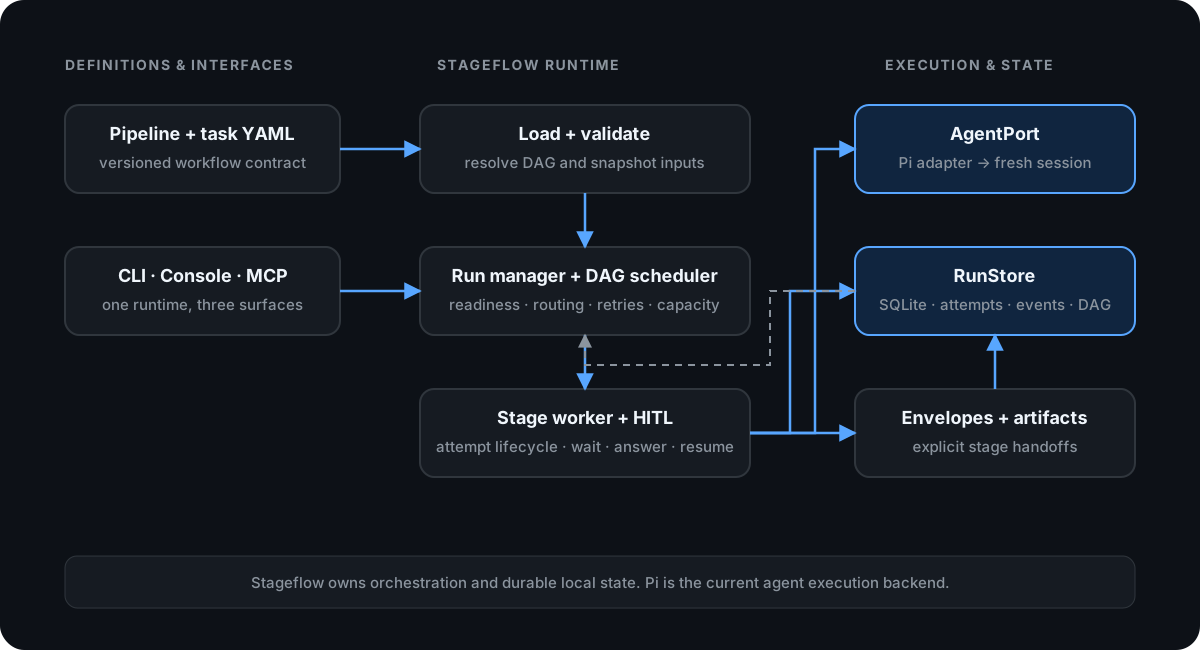
| Component | Responsibility | Primary code |
|---|---|---|
| Config loader | Load and validate manifests, tasks, stages, and resolved pipeline DAGs | src/config/ |
| Run manager | Start/resume coordination, run capacity, checkout leases, retries, startup reconciliation | src/runtime/runManager.ts |
| DAG scheduler | Readiness, bounded parallelism, routing, fan-out/join, Clone Chain instances, failure propagation | src/runtime/pipelineScheduler.ts |
| Stage runtime | Build attempt context, open the agent, validate handoff and optional after-phase verify, record activity, coordinate gates |
src/runtime/stageRunner.ts, src/runtime/verifiedStageExecution.ts, src/runtime/stageAttemptBootstrap.ts |
| Agent boundary | Stable stage input/result and live wait-or-complete session contract | src/agent/port.ts |
| Backend selection | Resolves which adapter a stage runs on (stage > pipeline > global > Pi). Model (LLM id) resolves separately with the same tier order but no "pi" fallback — see YAML catalog — Model defaults |
src/agent/resolveStagePort.ts, src/agent/agentBackend.ts, src/config/resolveModel.ts |
| Pi adapter | Translate Stageflow stage execution into Pi coding-agent sessions and tools | src/agent/piAdapter.ts |
| Claude adapter | Translate Stageflow stage execution into Claude Agent SDK sessions and tools | src/agent/claudeAdapter.ts, claudeTools.ts, claudeActivity.ts, claudeSession.ts |
| Agent service | Agent definitions, revisions, sessions, turns, approvals, channels and schedules; one turn-lifecycle module owns every transition | src/agents/ |
| MCP resolver | Merges the project .mcp.json with servers and secrets saved from the console; fills ${VAR} by caller scope (stage, agent, probe, validate) |
src/config/resolveStageMcpServers.ts, src/config/mcpHostCatalog.ts |
| Persistence | Store run metadata, DAG snapshots, attempts, events, envelopes, artifacts, and projections | src/runstore/ |
| Operator surfaces | Drive and inspect the same runtime through CLI, browser console, or MCP | src/cli/, src/server/, src/mcp/, ui/ |
Execution flow
- Load and validate. Stageflow resolves the selected pipeline and task, validates stage references and graph wiring, and resolves the checkout root.
- Create the durable run record. The runtime persists the task input, pipeline path, resolved DAG snapshot, checkout metadata, and a per-run workspace before scheduling work.
- Schedule ready stages. The DAG scheduler derives readiness from predecessor states and completed envelopes. Independent nodes can run concurrently up to configured per-run and process limits.
- Open an isolated stage attempt. In the default process mode, a stage worker opens a fresh agent session with the task, stage instructions, predecessor envelope data, and scoped workspace paths.
- Record activity. Logs and lifecycle events are appended to the run store while the stage works. Artifacts are written inside the run workspace instead of being embedded into transcripts.
- Validate the handoff. A successful stage emits a
StageEnvelope. Stageflow validates its status, summary, artifacts, optional payload schema, and routing fields before downstream stages consume it. - Run after-phase
verifywhen configured. Stageflow runs the declaredverifychecks after handoff validation, persists per-check evidence and the attempt's verification disposition, and accepts the candidate only when every required check passes. - Route or wait. Catalog
routelists successors; optionalifis evaluated against the success payload. Catalog YAML does not agent-select named successors viafork_choice. After a Clone Chain emitter succeeds, Stageflow schedules one Clone Instance per Clone Array element; the Join waits on those instances. If the agent callsask_operator, the stage parks aswaiting_for_inputuntil an answer is delivered through the console, MCP, or another supported operator path. - Continue, recover, or finish. The scheduler advances newly ready nodes, skips unreachable branches, applies
on_verify_fail(automatic repair or a manual operator decision), and derives the final run outcome from persisted stage state.
Handoff contract
Agent stages do not pass their full conversation histories to successors. They cross the boundary through a structured envelope:
type StageEnvelope = {
  status: "success" | "failure";
  summary: string;
  artifacts: string[];
  payload?: Record<string, unknown>;
  fork_choice?: string[];
  stage_id?: string;
  notes?: string;
};
The envelope is the control-plane handoff; artifacts are the data-plane handoff. A join stage can receive multiple predecessor envelopes without scraping or replaying their transcripts. fork_choice is not how catalog YAML chooses successors.
Persistence and recovery
SQLite is the active RunStore adapter. Run state is global, not per-project: it lives under the durable root ($STAGEFLOW_HOME, default ~/.stageflow/), with per-run and per-attempt workspaces under runs/. One RunStore instance backs every project on the machine; each run still records the project_root it came from, so views can be scoped back to one project. The same store holds a durable projects registry: catalog membership is seeded roots ∪ registered absolute folders. sf ui registers the directory it was started in. sf mcp does not. Local CLI ensure-then-starts against its resolved cwd; remotes may only target registered or seeded roots (unknown absolute project_root is refused). Per-project settings remain at <git-root>/.stageflow/settings.json. Pipeline/task files stay project-local under each registered (or seeded) root. See Data directory and MCP — catalog roots.
Stageflow persists:
- run metadata and a snapshot of the resolved DAG;
- stage attempts and lifecycle events;
- after-phase
verifyevidence and each attempt's verification disposition; - terminal envelopes and artifact paths;
- pending operator prompts and session context needed to resume a parked stage;
- projections used by the console and MCP resources.
Persisted state lets the runtime reconstruct scheduler state for HITL resume and targeted retries. On process startup, Stageflow reconciles runs whose workers disappeared rather than silently treating them as active. This is local durable state, not a claim of distributed exactly-once execution.
Human-in-the-loop lifecycle
StagePort.openStage() returns a live StageHandle. The runtime pulls either a completion or a waiting_for_input event. A waiting attempt is parked without converting the prompt into an unstructured failure. When the operator answers, Stageflow reconstructs the run context, delivers the opaque answer to the adapter, and continues the remaining DAG.
How an adapter actually survives that park is adapter-internal and deliberately allowed to differ: Pi reopens its own on-disk session and splices the answer directly into the pending tool call, then resumes mid-thought. The Claude adapter never lets a tool call go dangling in the first place — ask_operator returns an immediate placeholder and the turn ends cleanly (via an interrupt() backstop), so parking has nothing to repair; answering resumes the same session as a new turn with the real prior conversation reloaded, not mid-thought. Both satisfy the same StageHandle contract from the runtime's point of view.
This same lifecycle supports interactive console use and headless automation: CI exits with code 2 when a run requires input, while MCP clients can discover waiting gates and answer them programmatically.
Agents
Agents are a second, conversational way to run work beside pipelines. Each lives in agents/<id>.agent.yaml in the project (git-tracked), is synced into revisions in the run store, and runs on a Pi session sealed to the tools and approvals its definition grants. One turn-lifecycle module owns every change of a turn, its session and its approval, so a stopped turn cannot leave an approval pending. Channels, schedules, the console, CLI, MCP and the public web chat all enter through the same session and turn path. See Agents.
Design decisions
Fresh session per stage
Each stage starts with an intentional context boundary. This prevents an ever-growing shared transcript from becoming hidden workflow state and makes inputs reviewable. The tradeoff is that pipeline authors must decide what belongs in the envelope, payload, or artifacts.
Explicit envelopes over transcript scraping
Downstream behavior depends on validated fields instead of prose conventions inside another agent's chat history. This enables schema validation, route / join scheduling, Clone Chain instances, CI extraction, and retry reasoning. The tradeoff is a stricter completion protocol for stage authors.
Pipeline-owned YAML
Workflow topology and stage configuration live with the consuming project, where they can be reviewed and versioned. Stageflow validates structure but does not hard-code domain-specific stage types. YAML favors reproducibility over fully dynamic, agent-invented orchestration.
Orchestration behind ports
StagePort keeps scheduling and persistence code independent of any one adapter's session mechanics — proven out by a second production implementation (Claude Agent SDK) alongside Pi, chosen via resolveStagePort() and never affecting a stage that doesn't opt in. Model resolution (resolveModel) picks the LLM id string on a separate path from that backend choice. RunStore similarly keeps runtime call sites behind a persistence contract, even though SQLite is currently the only live adapter. These boundaries are extension seams, not promises that additional backends already exist — StagePort already redeemed that promise once.
Two backends, one contract
Pi and the Claude adapter satisfy StageHandle.next()/deliverAnswer()/close() identically, but are free to — and do — implement HITL wait/park/resume with completely different internal mechanisms (mid-thought session splicing vs. clean-stop-and-resume). Making one adapter's internals resemble the other's is not a goal; contract-level parity is. tests/agent.port.contract.test.ts and tests/agent.claudeAdapter.test.ts cover this from the port's side and the Claude adapter's side respectively — Pi's own mechanics are covered by its dedicated test files (tests/agent.piAdapter.*.test.ts) rather than a shared black-box harness, since Pi has no scriptable test seam equivalent to FakeAgent's or the Claude adapter's mocked-SDK tests.
Local-first operator control
The CLI, local console, and MCP server operate on the same run model. This keeps local and CI behavior aligned and makes stage state inspectable without introducing a hosted control plane. Stageflow is not currently a multi-tenant distributed orchestrator.
Trigger seam: schedule, GitHub poll, and email adapters
A TriggerDefinition (catalog *.trigger.yaml, see YAML catalog — Triggers) binds an addressable id to an existing pipeline + task. Firing one (sf trigger fire, POST /api/triggers/:id/fire) resolves those refs and starts a run through the same start_run path the CLI/MCP/console already use — no separate execution logic. TriggerSourcePort (src/runtime/triggerPort.ts) is the abstract seam anything that decides "fire trigger X now" would implement. schedule-kind triggers have a real adapter, ScheduleSource (src/runtime/scheduleSource.ts): croner-backed, ticking on a Host-owned interval, persisting each trigger's next_run_at so a restart doesn't lose or double-fire it, and catching up at most once for anything still due at boot rather than backfilling every missed interval. event-kind triggers watching github.* sources have a second real adapter, GithubPollSource (src/runtime/githubPollSource.ts): it ticks on its own Host-owned interval, groups triggers by distinct event.config.repo to bound API calls, and diffs each repo's PR list (conditioned on a persisted ETag) against a persisted cursor in the generic trigger_adapter_state table — a missed poll during a Host outage isn't lost, since the next tick's diff naturally catches up from the cursor, so unlike ScheduleSource it needs no boot catch-up tick. event-kind triggers watching email.* sources have a third real adapter, EmailSource (src/runtime/emailSource.ts) — architecturally different from the other two, since it's push-based rather than ticking on an interval: it opens a real IMAP connection per distinct mailbox (host+port+user) and holds it in IDLE, reacting to the server's own new-message notification, evaluating every trigger registered against that mailbox on each new message, and persisting a UID watermark in the same trigger_adapter_state table so a reconnect resumes from where it left off instead of re-firing already-seen mail. A dropped IMAP connection reconnects with bounded exponential backoff rather than going dark, and stop() tears down every open connection and pending reconnect timer so a Host shutdown stays clean.
Single global auto-starting service
There is one Stageflow background service per machine, not one per project. Where the Host process was started does not define the project set. sf ui and sf mcp start it explicitly; sf run and mutating sf runs verbs (answer, retry, resume, abandon, rerun, recover) are HTTP clients that probe the well-known local port and auto-start the service headlessly (<entry> mcp, detached) the first time anything needs it. Before start_run, sf run registers its resolved project folder with the Host (POST /api/projects on trusted loopback). This replaced an earlier one-process-per-project model that collided on port binding whenever more than one project or git worktree tried to run sf ui/sf mcp at once. Read-only sf runs verbs (list, show, verify, waiting) read the global store directly and don't require the service to be running.
Runtime invariants
- A stage becomes ready only when its required predecessors reach compatible terminal states. A single-parent child runs only after a succeeded parent (skip-cascade otherwise). A multi-parent Join runs if at least one parent succeeded; a failed parent leaves it pending; skipped siblings do not block.
- A successor consumes validated envelopes, not arbitrary predecessor transcripts.
- After-phase
verifyaccepts a successful handoff only after every declared check passes (on_verify_failis the fail policy; runtime IR still names this pathcompletion/recovery). - Run and stage lifecycle state is persisted before it is projected to operator surfaces.
- Waiting is a first-class state and is distinct from failure.
- Retries create new attempts and recompute affected downstream execution rather than rewriting prior history.
- The CLI, console, and MCP host drive the same runtime contracts.
Stage process in development
A published sf binary runs each stage as compiled dist/cli.js. npm run dev runs TypeScript, so the stage worker loads src/cli.ts through the tsx loader. If that process exits before it records a failure, the stage is marked failed.
Related documentation
- YAML catalog — pipeline, stage, task, route, join, loop, and Clone Chain configuration
- Envelopes — handoff schema, payload validation, and artifact rules
- Verified Stage Execution —
verify/on_verify_fail, evidence, and repair policy - Human-in-the-loop — gate kinds, waiting behavior, and resume paths
- CI / headless — JSON output, exit codes, and GitHub Actions
- MCP — tools and run resources
- Operator console and Agents
- MCP servers
- YAML catalog — Stage MCP — stage agents consuming project MCP servers
- Operator console — runtime inspection and gate handling
- Workshop Author — chat-draft a pipeline and save it into the catalog